
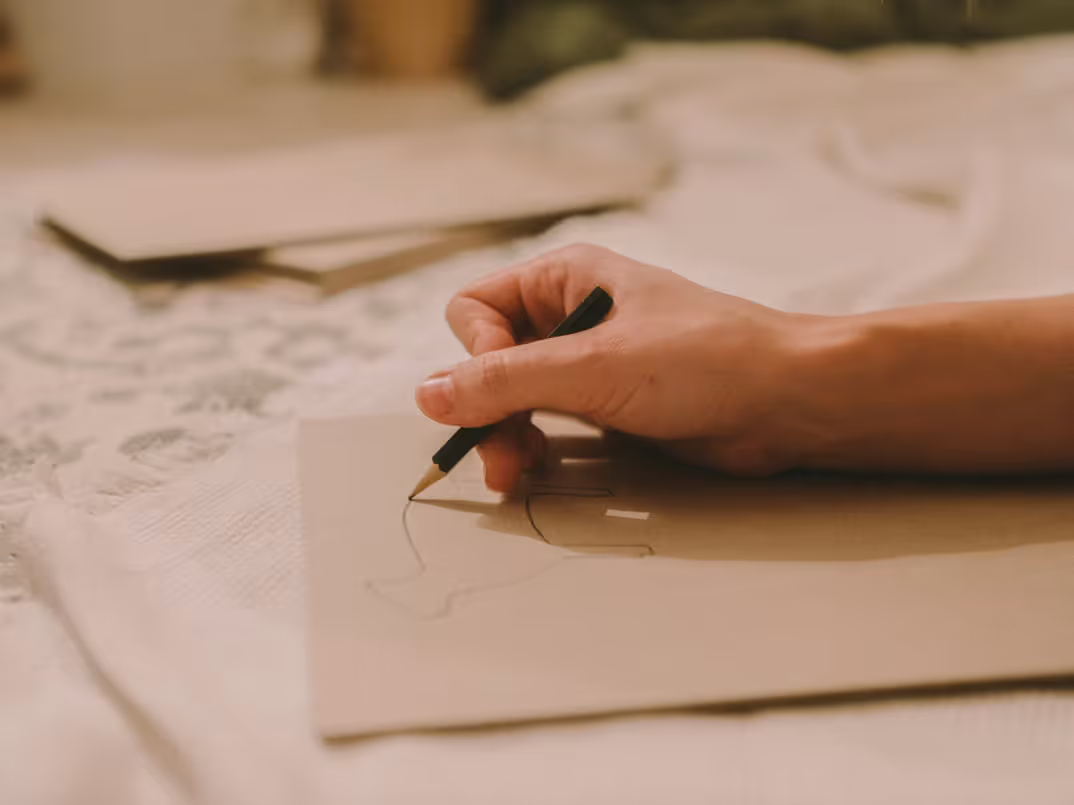
Visitors usually encounter artworks only after months or even years of creative development. A painting hangs in a gallery with quiet confidence. A sculpture occupies a public square as though it had always belonged there. A photograph appears complete within a carefully framed print.
What remains unseen is where many of these ideas first began.
For countless artists, that place is a sketchbook.
Far more than collections of quick drawings, sketchbooks function as visual journals where observations, questions, colour studies, written notes, compositional experiments, and unexpected discoveries gradually accumulate. Some pages contain carefully rendered studies, while others are filled with loose marks, crossed-out ideas, and fragments that may never become finished artworks.
This freedom is precisely what makes sketchbooks so valuable.
Unlike exhibitions or commissioned projects, sketchbooks exist without the pressure of completion. Artists use them to test possibilities, record fleeting observations, and solve creative problems long before materials such as paint, clay, bronze, or glass are introduced.
Collectors and museum visitors rarely see these private working documents, yet they often provide the clearest insight into how artists think. A finished artwork may communicate confidence, but a sketchbook reveals curiosity. It captures the moment when uncertainty still exists and every idea remains open to exploration.
Understanding the role of sketchbooks reminds us that creativity is rarely a single moment of inspiration. It develops gradually through observation, revision, and a willingness to keep asking questions long before final answers appear.
Drawing as a Way of Thinking
Many artists describe drawing not simply as a technical skill but as a way of thinking.
Sketching slows observation.
Rather than glancing briefly at a landscape, object, or figure, artists begin noticing proportion, rhythm, light, texture, and relationships that might otherwise remain overlooked.
Every line becomes an act of investigation.
Some sketches explore composition.
Others focus on movement.
Many exist only to understand how an idea might develop further.
This process encourages active looking rather than passive seeing.
For collectors, recognising drawing as a form of research deepens appreciation for finished works, revealing how complex artistic decisions often begin with remarkably simple marks on paper.
A Space Without Perfection
Unlike completed artworks displayed publicly, sketchbooks are rarely expected to be perfect.
Pages contain mistakes.
Ideas overlap.
Annotations appear beside unfinished drawings.
Some compositions are abandoned after only a few lines.
This absence of pressure allows experimentation to flourish.
Artists frequently discover unexpected solutions precisely because they feel free to explore without worrying about immediate success.
Sketchbooks therefore become places where failure is not avoided but welcomed as part of creative learning.
Many finished masterpieces owe their existence to pages that, at first glance, appear unfinished or uncertain.
Recording Everyday Observation
Not every sketch leads directly to a painting or sculpture.
Many simply record moments of everyday life.
Architectural details.
Shadows crossing a room.
Plants observed during travel.
Interesting gestures.
Changing weather.
Unexpected colour relationships.
Over time, these visual notes become personal archives that artists revisit repeatedly.
Ideas recorded months or even years earlier often return unexpectedly within future projects.
The sketchbook preserves these observations until the right creative opportunity arrives.
From Sketch to Finished Artwork
The journey from sketchbook to completed artwork is rarely straightforward.
An artist may revisit the same idea dozens of times before feeling ready to begin a final piece. A small pencil drawing might eventually become a large-scale painting, while a simple geometric study could evolve into a public sculpture or architectural installation.
Along the way, countless decisions reshape the original concept.
Compositions become more balanced.
Colour palettes change.
Materials are reconsidered.
Elements are removed while unexpected additions emerge.
The finished work often retains only the essential spirit of the first sketch rather than reproducing it exactly.
This gradual transformation demonstrates that creativity is not a linear process.
Instead, artists refine ideas through continuous observation, experimentation, and revision until the work reaches its own natural conclusion.
For collectors, seeing early sketches alongside completed works offers a rare opportunity to witness artistic thinking as it unfolds over time.
Why Collectors Appreciate Original Sketches
Although paintings and sculptures often receive greater attention, original sketches possess a quiet significance that many collectors deeply value.
They reveal the artist at a moment of exploration rather than completion.
A sketch may capture the first appearance of an idea, record an unexpected solution to a compositional problem, or preserve visual notes made during travel, research, or everyday observation.
Because of their informal nature, sketches often feel remarkably personal.
Collectors appreciate their immediacy.
Every pencil line, erased mark, handwritten annotation, or colour study reflects direct engagement between artist and paper without the refinement expected of finished works.
These qualities make sketches valuable not because they are incomplete, but because they reveal aspects of artistic practice rarely visible elsewhere.
Sketchbooks in Museum Collections
Many museums actively preserve artists' sketchbooks alongside finished artworks.
These working documents provide scholars with invaluable insight into creative development, allowing researchers to understand how projects evolved through successive stages of experimentation.
A sketchbook may reveal:
- Early compositional studies.
- Material experiments.
- Written reflections.
- Travel observations.
- Architectural references.
- Preparatory drawings for paintings or sculptures.
Viewed together, these pages become visual records of artistic thought.
Museum exhibitions occasionally display sketchbooks beside finished works, inviting visitors to compare first ideas with completed artworks. This relationship encourages deeper appreciation for the patience, revision, and problem-solving that define creative practice.
Rather than diminishing the mystery of art, sketchbooks enrich it by revealing how imagination gradually takes form.
Why Every Artist Keeps Looking
One of the most remarkable qualities shared by experienced artists is their commitment to observation.
Even after completing successful exhibitions or major commissions, many continue carrying sketchbooks wherever they travel.
The purpose is not always to create finished drawings.
Sometimes a single page records changing light across a building.
A handwritten sentence beside a quick sketch may preserve an idea worth exploring months later.
Other pages simply encourage slower looking.
This habit reflects an important truth.
Creative growth does not end when an artwork is completed.
Artists remain students of the world around them, continually collecting visual experiences that may eventually become part of future projects.
The sketchbook therefore remains a lifelong companion rather than merely a training tool.
A Record of Creative Curiosity
Unlike polished portfolios or finished exhibitions, sketchbooks rarely attempt to impress anyone.
They exist as private spaces where questions matter more than answers.
Over months and years, these pages accumulate observations, experiments, mistakes, discoveries, and evolving interests.
Together they become visual biographies documenting an artist's intellectual and creative journey.
For historians, they provide evidence of artistic development.
For collectors, they deepen appreciation for finished works.
For artists themselves, they preserve moments of curiosity that continue shaping future ideas.
In many ways, the sketchbook is the one place where creativity remains completely free to evolve without expectation.
Collector's Insight
A finished artwork reveals what an artist decided to show the world. A sketchbook reveals how they learned to see it.
Conclusion
Every memorable artwork begins long before the first brushstroke on canvas or the first piece of stone is carved. It begins with observation, curiosity, and the willingness to explore ideas without certainty. Sketchbooks provide artists with a space where experimentation can unfold naturally, allowing questions to develop into compositions and fleeting impressions to become lasting works of art.
For collectors, understanding the role of sketchbooks offers a richer appreciation of artistic practice. Finished artworks become more than refined objects—they become the visible outcome of countless drawings, revisions, notes, and discoveries that gradually shaped the artist's vision. This creative process reminds us that mastery is rarely the result of sudden inspiration but of continuous learning and thoughtful exploration.
Whether preserved in museum archives, displayed alongside completed works, or kept privately within an artist's studio, sketchbooks remain among the most revealing documents in the creative world. They remind us that every masterpiece once existed as nothing more than an idea waiting to be explored.
Explore thoughtful editorial features on artists, creative practice, collecting, and the stories behind exceptional works of art through ModernPress.
Related Story
How Emerging Artists Build Successful Careers

Genevieve Laurent
Contemporary art journalist focused on emerging artists, gallery exhibitions, and the evolving global art scene. She regularly covers major art fairs and cultural institutions.