
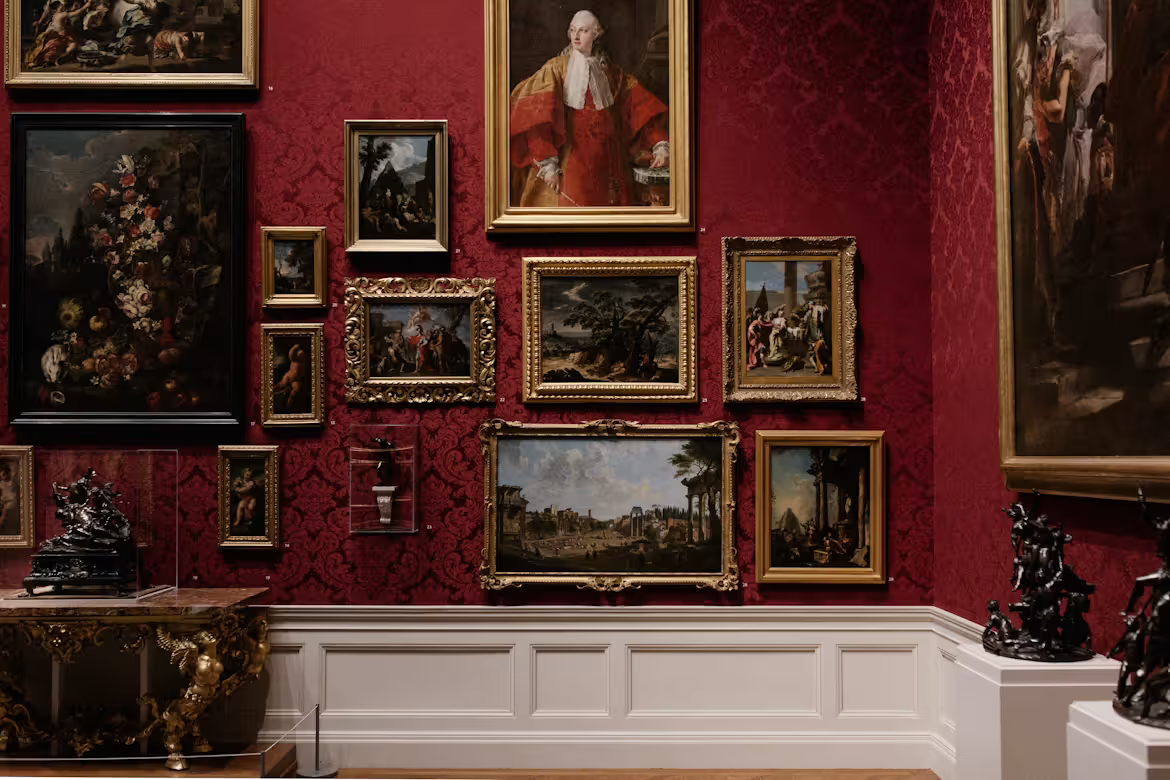
Visitors walking through a museum rarely think about what happens before an artwork reaches the gallery wall. Paintings appear perfectly lit, sculptures seem timeless, and delicate photographs rest quietly behind protective glass. The experience feels effortless.
Behind every exhibition, however, lies an extraordinary amount of invisible work.
Long before visitors arrive, conservators examine each artwork with remarkable care. They study pigments, fibres, wood, canvas, stone, ceramics, metals, and photographs to understand how time, light, humidity, and previous restorations have affected their condition. Every decision is supported by research, scientific analysis, and a deep respect for the artist's original intent.
Museum conservation is one of the most fascinating intersections between art and science. Conservators combine historical knowledge with chemistry, material analysis, microscopy, photography, and meticulous documentation to protect artworks without altering their cultural significance. Their work requires patience measured not in hours, but often in weeks, months, or even years.
For collectors, understanding conservation transforms the way artworks are appreciated. Paintings become more than beautiful images. Sculptures reveal the challenges of preserving different materials. Historic photographs demonstrate the fragility of paper and light-sensitive processes. Every object carries a physical history that requires thoughtful stewardship.
Conservation reminds us that preserving art is not simply about protecting objects. It is about protecting the stories, craftsmanship, and cultural memory those objects continue to represent.
Understanding Conservation
Conservation is often confused with restoration, yet the two practices serve different purposes.
Restoration generally involves carefully repairing visible damage so an artwork can be understood more clearly. Conservation has a broader objective.
Its primary goal is to slow deterioration while preserving as much original material as possible.
Conservators document every stage of their work, ensuring future specialists understand exactly what treatments have been performed.
This emphasis on transparency protects both the physical artwork and its historical integrity.
Rather than attempting to erase the passage of time completely, conservators seek to stabilise artworks so they may continue existing safely for generations to come.
Science Meets Craftsmanship
Museum conservation combines traditional craftsmanship with advanced scientific investigation.
Before beginning treatment, conservators often examine artworks using specialised imaging techniques, magnification, ultraviolet light, infrared photography, and material analysis to better understand how they were created.
These examinations reveal remarkable details.
Hidden sketches beneath paintings.
Earlier repairs.
Changes made by artists during the creative process.
Natural ageing of pigments and varnishes.
Evidence of environmental exposure.
This information helps conservators make informed decisions while respecting both the artwork's physical structure and historical significance.
Every treatment is guided by careful observation rather than assumption.
Every Material Ages Differently
No two artworks age in exactly the same way.
Oil paintings respond differently to humidity than watercolours.
Bronze develops protective patinas.
Wood expands and contracts with changing environmental conditions.
Paper becomes increasingly sensitive to light.
Photographs require carefully controlled storage.
Glass, ceramics, textiles, and mixed-media installations each present their own conservation challenges.
Understanding these differences allows museums to create appropriate environmental conditions for every object within their collections.
Temperature, humidity, lighting, handling, storage, and transportation are all carefully monitored to minimise unnecessary deterioration.
Preventive Conservation: Protecting Art Before Damage Occurs
One of the most important responsibilities of a museum conservator is preventing damage before restoration ever becomes necessary.
This approach, known as preventive conservation, focuses on creating stable environments where artworks can age naturally without unnecessary deterioration.
Museums carefully monitor factors such as:
- Temperature
- Relative humidity
- Light exposure
- Air quality
- Pest management
- Handling procedures
- Storage conditions
Even small environmental changes can affect sensitive materials over long periods. Excessive humidity may encourage mould growth, while overly dry conditions can cause wooden objects to crack or painted surfaces to become unstable. Paper and textiles gradually fade when exposed to strong light, making controlled illumination essential during exhibitions.
Preventive conservation often receives little public attention because successful preservation is intentionally invisible. Visitors simply experience artworks in excellent condition without realising the extensive planning that makes this possible.
The Ethics of Conservation
Conservation is guided by a strong ethical framework that places respect for the artwork above aesthetic perfection.
Conservators avoid altering original materials unless absolutely necessary. Whenever treatments are carried out, they are carefully documented so future professionals understand exactly what has been changed and why.
Another important principle is reversibility whenever possible.
Many conservation materials are selected because they can be safely removed in the future if improved techniques become available. This ensures that today's decisions do not unnecessarily limit tomorrow's possibilities.
Rather than attempting to erase every sign of age, conservators recognise that natural ageing forms part of an artwork's history.
Small surface changes, subtle craquelure in paintings, or gentle wear from centuries of careful handling often contribute to an object's authenticity rather than diminishing it.
The goal is preservation—not perfection.
What Private Collectors Can Learn
Museum conservation principles extend well beyond public institutions.
Private collectors can significantly improve the long-term preservation of their collections through relatively simple practices.
Important considerations include:
- Avoid displaying artworks in direct sunlight.
- Maintain stable indoor temperature and humidity.
- Handle artworks with clean hands or appropriate gloves when necessary.
- Use professional framing and archival-quality mounting materials.
- Keep detailed documentation for every acquisition.
- Schedule condition assessments for significant works when appropriate.
Collectors should also resist the temptation to undertake restoration without professional guidance.
Well-intentioned repairs using unsuitable materials can create challenges that become increasingly difficult to address later.
Thoughtful care ensures that artworks remain both visually rewarding and historically authentic.
Technology and the Future of Conservation
Advances in technology continue expanding the conservator's ability to understand artworks without causing harm.
High-resolution digital photography allows specialists to monitor subtle changes over time, while multispectral imaging reveals information hidden beneath visible paint layers. Three-dimensional scanning helps document sculpture with exceptional precision, and microscopic analysis assists researchers in identifying pigments, fibres, and binding materials.
Digital documentation has also transformed museum record keeping.
Every treatment, environmental measurement, condition report, and examination can now be carefully archived, creating detailed histories that support future research and conservation.
Despite these innovations, technology remains a tool rather than a replacement for professional judgement.
Successful conservation continues to depend upon observation, experience, patience, and respect for the artwork itself.
Conservation as Cultural Stewardship
Every artwork preserved today becomes part of tomorrow's cultural heritage.
Conservators therefore work not only for present-day museum visitors but also for future researchers, artists, students, and collectors who will continue learning from these objects for decades to come.
This long-term perspective shapes every decision.
Whether stabilising a centuries-old painting, preserving a contemporary installation, or preparing delicate photographs for exhibition, conservators balance immediate needs with future responsibility.
Their work rarely attracts public attention, yet it quietly supports nearly every museum exhibition around the world.
Without conservation, many of the artworks that inspire millions of visitors each year would gradually disappear.
Collector's Insight
The best conservation work is often invisible. Its greatest achievement is allowing future generations to experience an artwork without noticing the effort required to preserve it.
Conclusion
Museum conservation is one of the least visible yet most essential disciplines within the art world. By combining scientific research, technical expertise, historical knowledge, and careful craftsmanship, conservators ensure that paintings, sculptures, photographs, textiles, and countless other cultural objects remain accessible for future generations.
For collectors, understanding conservation encourages a deeper appreciation of every artwork's physical history. Great works of art are not timeless simply because they survive—they endure because dedicated professionals and responsible collectors invest in their long-term care. Every condition report, environmental adjustment, and conservation treatment contributes to protecting both artistic achievement and cultural memory.
Ultimately, conservation reminds us that collecting and preserving art are closely connected responsibilities. The greatest legacy of any collection is not only the objects it contains but also the care taken to ensure those objects continue inspiring audiences for generations to come.
Discover thoughtful editorial features exploring museums, conservation, collecting, craftsmanship, and the people working behind the scenes to preserve the world's artistic heritage through ModernPress.
Related Story
How Curators Build Exhibitions That Tell Stories

Isabelle Fontaine
Culture writer exploring museums, exhibitions, artistic movements, and the stories behind influential works of art. Her reporting connects art with everyday cultural life.